Sunday, 30 October 2016


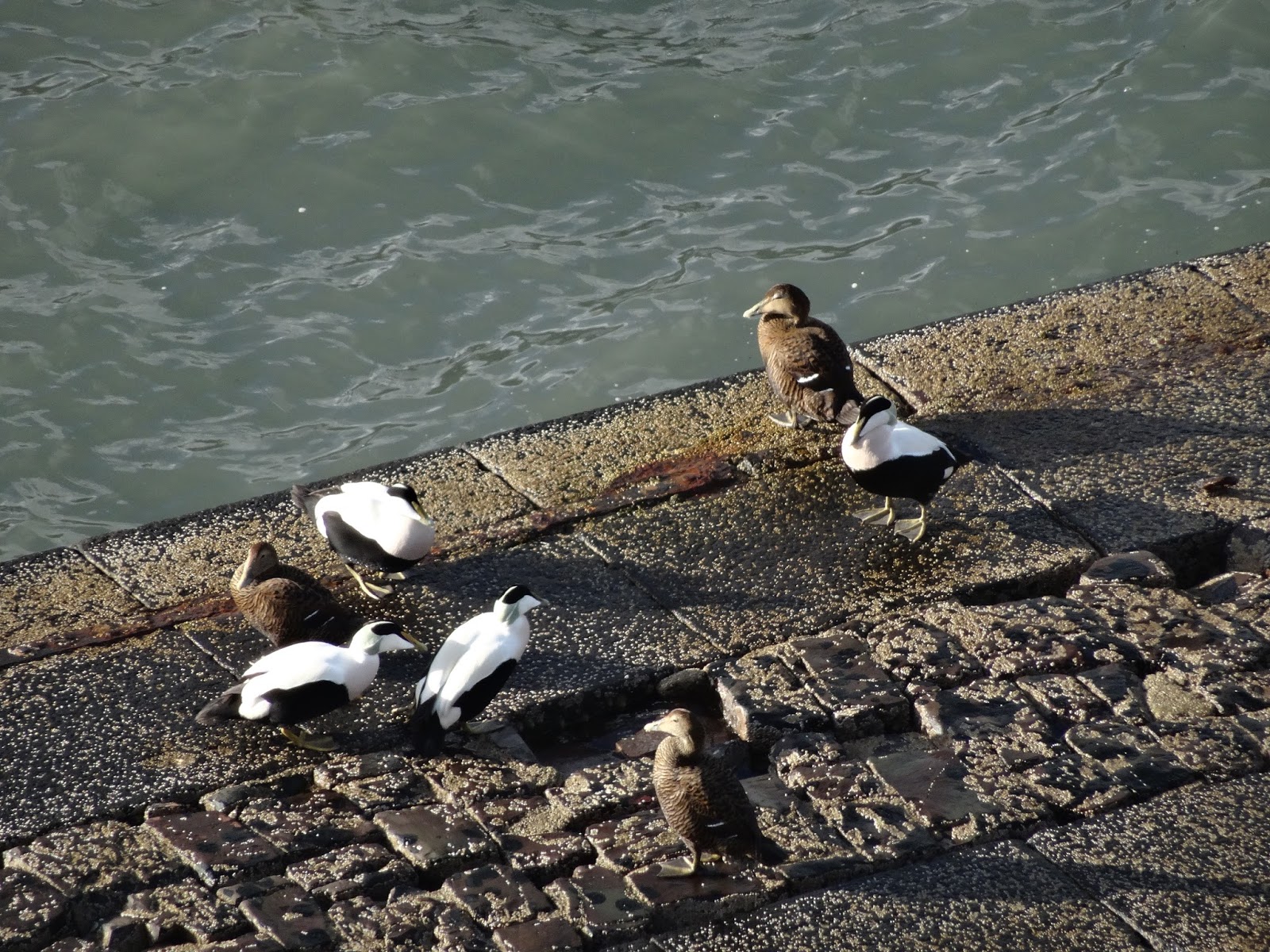
I spotted this group of Eider Ducks on the old jetty at Petticowick the other day. Although they are elegant birds on the water, and excellent at swimming underwater, they were having a bit of trouble staying upright on the slippery jetty surface.  Lizy.

Eider Ducks Somateria mollissima

Wednesday, 26 October 2016

I caught these beautiful autumn colours on the path to Starney Bay the other day, in between heavy rain showers! Keep an eye out for Waxwings which come over from Scandinavia at this time of year and love eating berries from trees like this. At least one of these beautiful pink birds has already been spotted this year at nearby Burnmouth.


http://www.rspb.org.uk/discoverandenjoynature/discoverandlearn/birdguide/name/w/waxwing/

Lizy


Monday, 17 October 2016

We had a fantastic time with the National Trust for Scotland's Lothian Conservation Volunteer group this weekend. The mission was gorse bashing, a vital task for preserving our wonderful grasslands, and we certainly got a lot done. Unfortunately it was too wet and windy to burn anything we cut, so expect to see a bonfire regularly as we try to burn our way through the enormous amount of gorse that was cut! Thanks again to everyone who came out and gave us a hand (24 people over the whole weekend!). Lizy

Lothian CVs clearing a large area of gorse near the Mire Loch

Wednesday, 12 October 2016


This morning I was down at the Mire Loch with Lizy and our volunteers Bill and Jean. We started off by setting up a siphon to lower the water level in the Mire Loch so we can carry out some more repairs to the dam. Then Lizy, Bill and Jean then went off to do some fence mending and I went for a walk around the loch to check how everything was doing and to put together a "to do" list for our new long term volunteer, Ed, who is starting with us next week. I stepped off the path into the trees to have a quick wee just as a sparrowhawk carrying prey chose to fly through that particular bit of woodland. Talk about being in the right place at the right time, it was there and gone within a couple of seconds! No chance to get a photo, but here is one I have borrowed off the net to give you an idea. Lots of other bird activity down there too - the trees were zinging with goldrests, blackbirds galore and redwings flying over calling too. Then I had a great view of two roe deer springing away across the field as I cam to the top of the Mire Dean.  Who says there's nothing to see here outside the summer months?! Liza.

Tuesday, 11 October 2016

24 hours later and you can see that the ink caps are deliquescing nicely. The one at the top left has almost entirely melted into black spore-carrying goo since yesterday morning. Lizy

Shaggy Ink Caps deliquescing nicely

Monday, 10 October 2016

If you happen to be in the reserve car park in the near future then do check out the fantastic display of Shaggy Ink Caps which are growing right beside some of the car parking spaces. They won't be around forever though - this striking fungus spreads its spores by gradually melting, or deliquescing, into a black, inky liquid, and you can see that the top left hand mushroom is already melting away.  Lizy

Shaggy Ink Cap Coprinus comatus

Thursday, 6 October 2016


There have been hundreds of Barnacle Geese flying over the reserve today, migrating south from their breeding grounds in the Arctic Circle, the first we’ve spotted this year.  If you have binoculars you’ll be able to spot that these smart birds are black and white, rather than brown like the Pink-footed Geese which are also flying south at the moment.  If you don’t have any visual aids though, you can still pick out a skein of barnacle geese as they make a very different sound.  Listen out for a short yapping sound, like small dogs barking:  http://www.xeno-canto.org/270041  Pink-footed Geese, on the other hand, make a very distinctive, high pitched “wink wink” call: http://www.xeno-canto.org/324770.  Lizy
Barnacle Geese Branta leucopsis, flying over

Monday, 26 September 2016


The migrant birds continue to come through. One of our volunteers, Fran, had great view of 4 Lapland buntings up near the lighthouse yesterday along with more common sightings like wheatear. I don't have a photo of one myself, so have borrowed this one off the net to give you the gist. Liza.

Friday, 23 September 2016


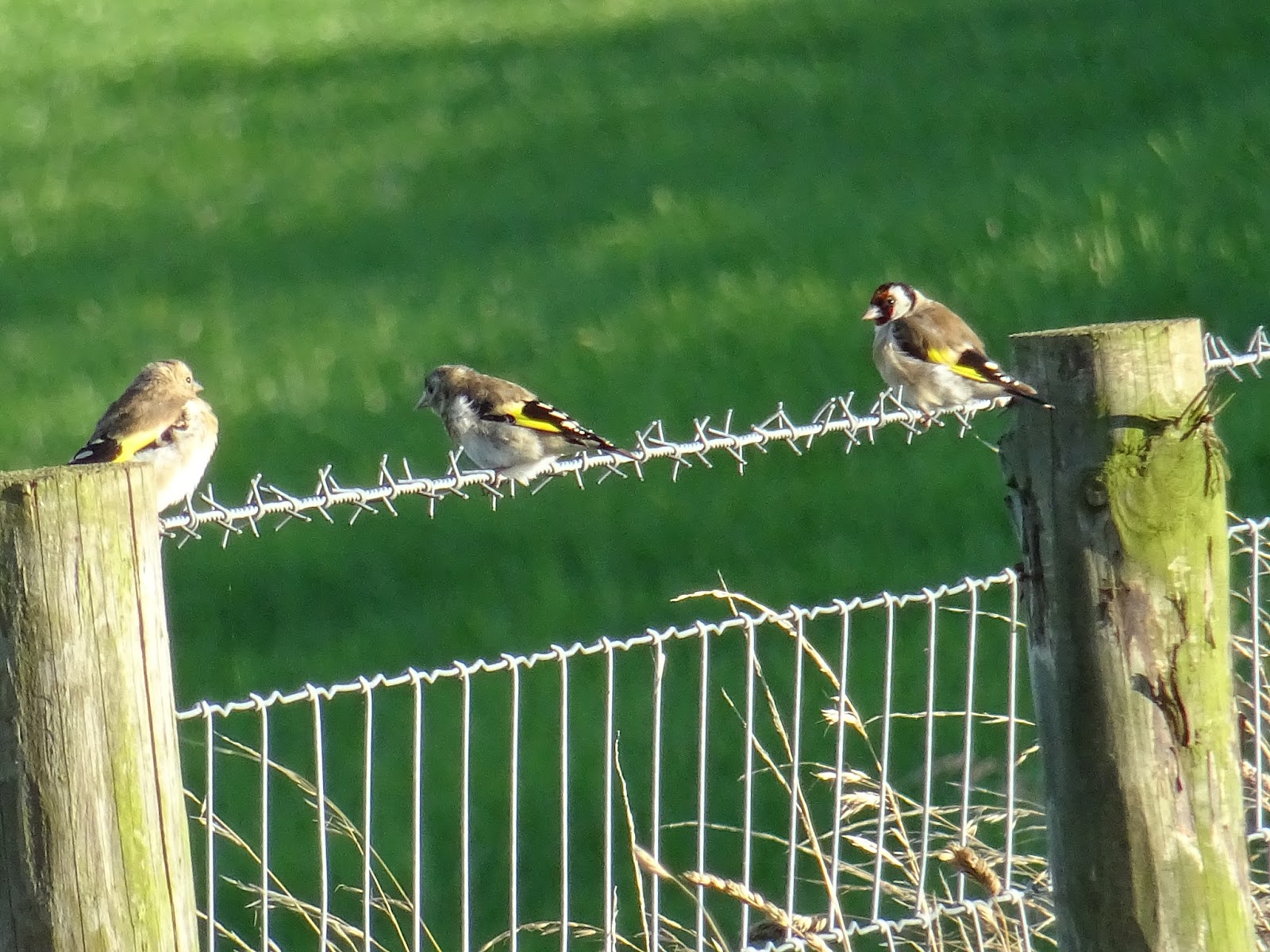
So, today is the first day of autumn, being the day after the equinox. We've had a fair few migrants passing through over the last few weeks, always a sign of autumn: pied wagtails, wheatears, various warblers and tits and there have been flocks, or should I say charms, of goldfinch around too. These beautiful birds have been feasting on the thistle heads and on the knapweed in the Rangers' Office garden too. They are pretty mobile birds, but I did manage to get a wee snap of them. We've not had anything terribly unusual come through on migration, but we have had a yellow-browed warbler or two, which is nice. Liza.

Tuesday, 20 September 2016

This year's State of Nature Report was published earlier this month. This link gives you a useful summary but also links to the full report and the separate ones for England, Wales, Scotland and Northern Ireland. Liza.


https://www.bto.org/research-data-services/publications/state-nature/2016/state-nature-report-2016?dm_i=IG4,4HB87,39H4VD,GJOF6,1

Saturday, 17 September 2016

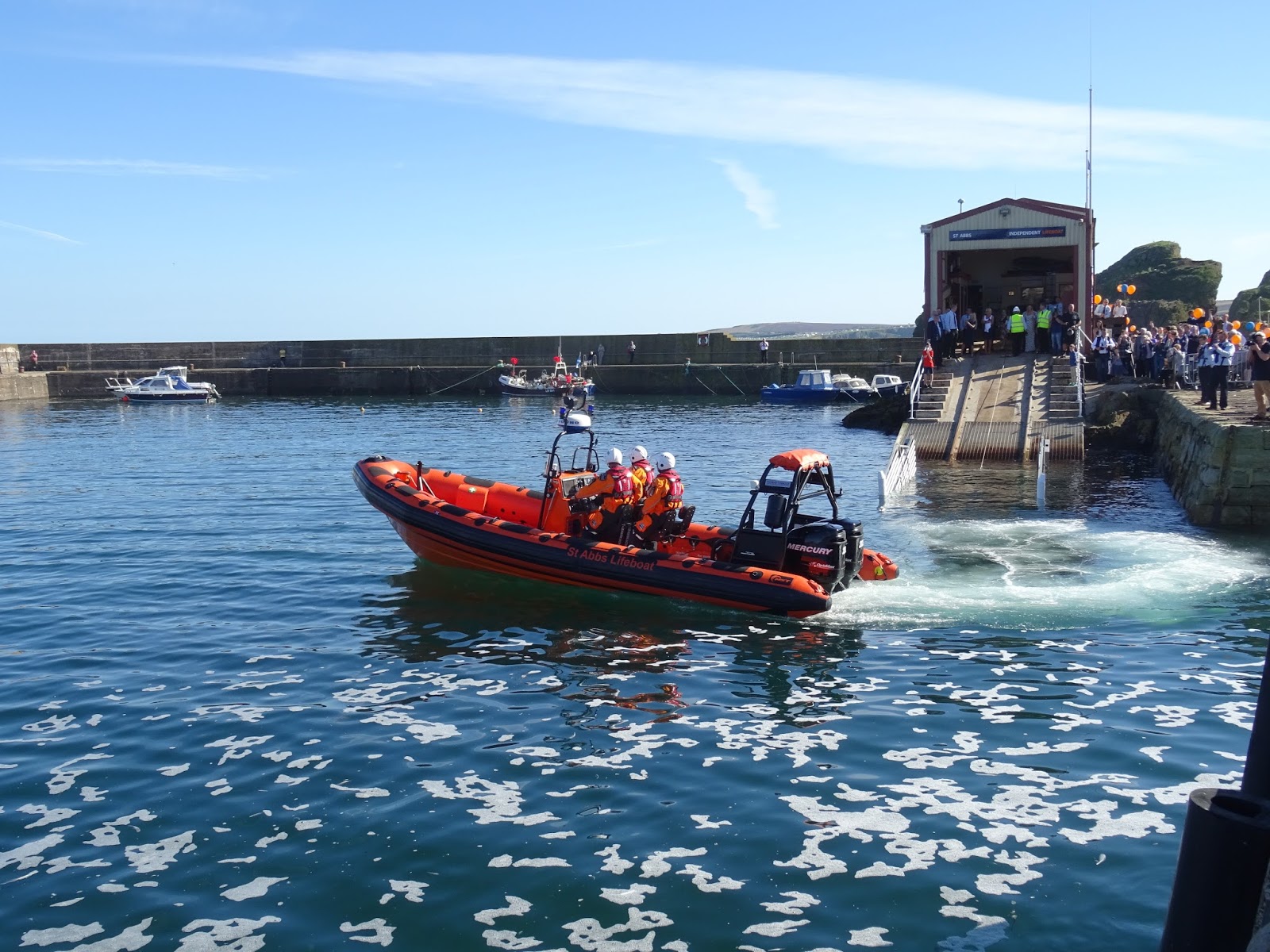
Today was a momentous day - the day of the official launch of St Abbs Independent Lifeboat - less than a year after the RNLI decided to take their lifeboat away from the village. The weather was perfect, and the village was buzzing with people who had come from near and far to see the launch. A brilliant day.  Liza.

The Thomas Tunnock leaves the cradle officially for the first time.

Showing off the vessel's capabilities to the crowd - and why not!

Thursday, 15 September 2016

Yesterday I was at a training day on wildlife crime - interesting stuff., if a little difficult to stomach at times. We covered many things, including which forms of trapping are legal, and which aren't - the trap shown in the photo, a Larsen trap, is legal. Liza.


Monday, 12 September 2016

Today Lindsay Mackinlay, one of the NTS's Nature Conservation Advisors, came for a site visit. He came to discuss various things, but also, as he is trained and licenced to do so, he also checked our bat boxes whilst he was here.


Usually checking bat boxes involves finding a lot of cobwebs, some poo (of which a sample is taken and sent away for DNA analysis to ID the species), and maybe the odd birds nest, but little else. But today he found a bat roosting in one box, very exciting, and even got a photo! Lindsay identified it as a Pipistrelle but we will have to wait to see what the DNA analysis of its poo tells us before we know if it is a common or a soprano pipistrelle (the only other way to tell is by the frequency of the echolocation call). Here's a few photos. Liza.


Checking the box at the office - nothing, not even poo!
Down by the Mire Loch we were more lucky with this wee Pipistrelle in one box.
This box was empty, but there's lots of evidence of bats being in it recently - notice the grease stain in the top left of the box - this came of a bat's fur, and plenty of fresh poo at the bottom of the box.

Wednesday, 7 September 2016

It's not just our human visitors who have been enjoying the fantastic sun we've been having here at St. Abb's Head. The rabbits on the slopes of Kirk Hill have been taking the opportunity to relax and do some sun-bathing too.  Lizy

European Rabbit Oryctolagus cuniculus

Sunday, 4 September 2016

If you happen to be walking around the Mire Loch and hear an incessant, high pitched begging call coming from the water, then you've probably found our brood of Little Grebes. This is the second brood on the Mire Loch this year, with another brood of a single chick recorded earlier in the summer. Young Little Grebes are attractive beasts, striped black and white on the head with bright orange/yellow beaks. Although this is normally a small, and quiet bird which can be difficult to see, these chicks are not shy about advertising their presence, and as the adults are constantly busy collecting fish and invertebrates to feed them, they are easy to spot at this time of year.  Lizy

Little Grebe chick Tachybaptus ruficollis

Adult Little Grebe feeding chick

Thursday, 1 September 2016


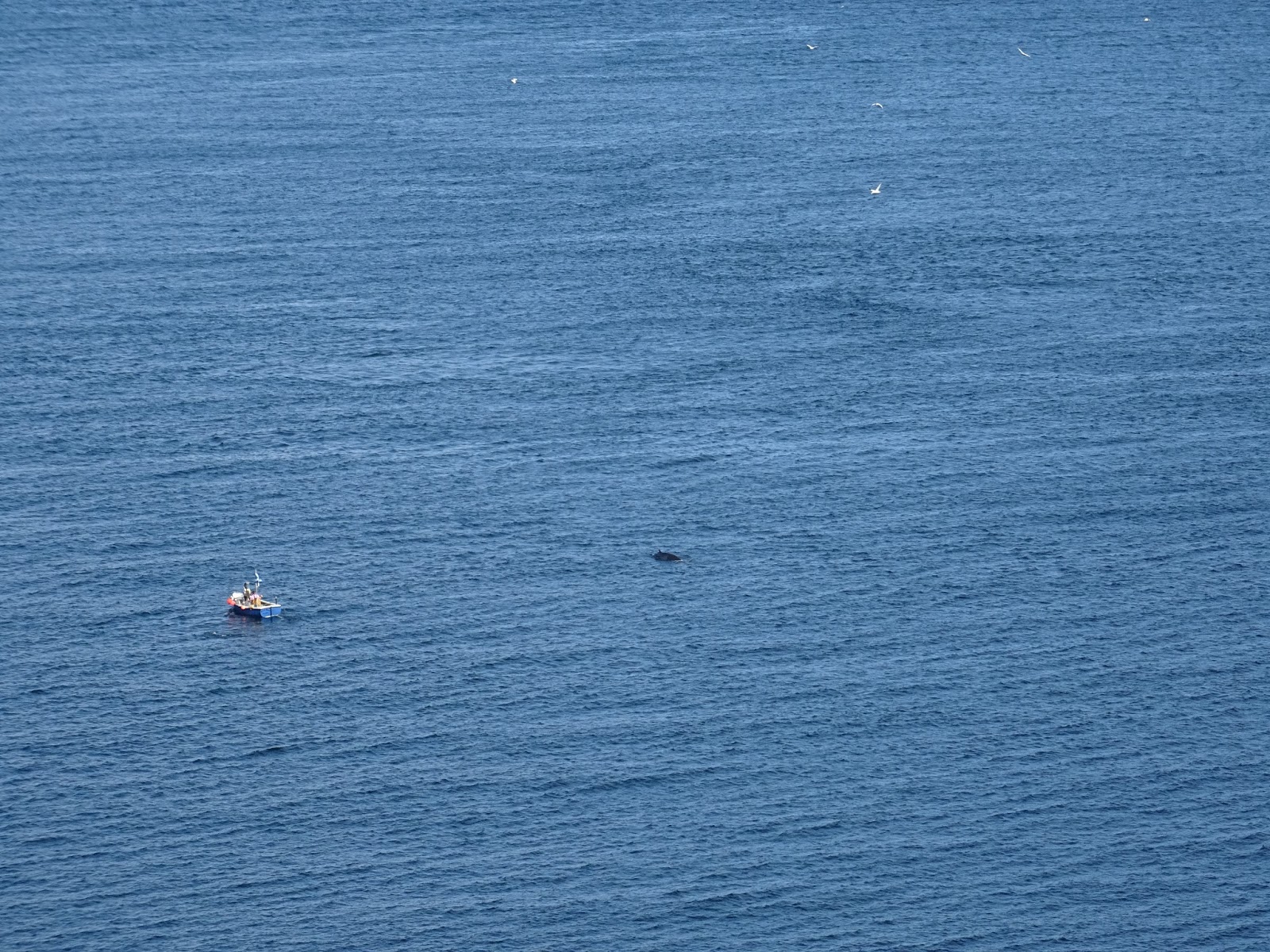
The minke whales were showing well at the Head again this morning. That's a fair few mornings in a row, so if you want to see them, I suggest you get up there as this is your best chance! Look out where the birds are feeding as they are all after the same thing - fish! In fact, this morning one of the local creel fishermen was up there too catching fish (I would guess mackerel) to bait his creels with. This morning there were a whole load of seals hauled out on the rocks just below the lighthouse too, singing and snorting - also an unusual occurrence at the Head, believe it or not. Liza.


All the drainage work is now complete at Starney Bay so the area has gone back to being its usual peaceful place to be. We have put some stone on the disturbed area of path so that it doesn't get muddy when the rains come. We have also cordoned of the disturbed area near the cliff edge to let it settle and maybe green over a wee bit before autumn hits. Thanks for bearing with us, let's hope its solved the issue. Liza.

Wednesday, 31 August 2016

This evening we started some essential repair work on the coast path above Starney Bay (the first bay along from St Abbs village). Over the last couple of years were have had a series of small landslips that have been nibbling away at our land and threatening the coast path. This has been of great concern to us and we have been having many discussions behind the scenes with engineers, rope access contractors, footpath experts, drainage experts and our neighbours at Northfield Farm. Today, at last, we have been able to start work to try and solve this issue and safeguard the coast path.

What we are doing is installing new, deep, drains in Northfield Farm's field to pick up the old land drains that don't seem to be able to be up to the job any more, and take the water underneath the coast path and off the cliff. We didn't want to have to close the path as its so popular, so we decided to do the work in the evening when less people use it. Our plan worked, we only had to down tools once to escort people through, and by 8pm we had the stretch under the coast path laid and backfilled. Work will carry on in the field for the next day or so, which means there will be a bit of noise, but the path is free for you to use again.

We have cordoned off the area nearest the cliff edge, just to give the ground time to settle and with the hope that we might have time for it to grass up a little before the autumn. Which leads to a question I bet is on many people's lips - why do the work in August, one of the busiest times of year? The answer is simple - we had to wait until the field was harvested - not a time we would have chosen I assure you.

I really hope that this has solved the issue. We will keep a close eye on things over the winter, and if we have no further landslips, we will be able to open up the path down to Starney Beach again (we have had to close it as it passes directly beneath the area of landslips). Fingers crossed! Liza.


Managed to get a few photos of one of the three Minke Whales just off the lighthouse this morning. I watched them for about an hour as they swam around feeding. They were surrounded by Gannets, Shags, and several Grey Seals, all busy feeding. Minke Whales and Bottlenose Dolphins have now been reported here nearly every day for the last 4 days, so if you've always wanted to see one now is possibly the time! Lizy

Minke Whale Balaenoptera acutorostrata

Tuesday, 30 August 2016


Yesterday I was down at St Mary's Lighthouse at Whitley Bay with some friends - to see the lighthouse, and the tall ships and the seals. We had a lovely time, but unfortunatley there were no seals hauled out on the rocks and just a few to be seen in the sea off the rocks. Sadly this is due to human disturbance; much of it being folk who go especially to see the seals - such a shame.
 
However, we did bump into some of the brilliant local people people who volunteer as St Mary's Seal Watch. When the tide is out they man the area and chat to folk making them aware of the potential consequences of their actions. When we were chatting, I found out that what they could really do with (apart from more enthuisastic volunteers, obviously) is more binoculars and telescopes. Luckily, we happen to have some that we were using up until this season, when we got a donation to buy some new ones. I have been hanging on to the old ones, wondering what I could do with them, and I am pleased to say that we can now pass them on to an(other) good cause!


Brilliant to make that connection too, seals don't just stick in one area, they wander over quite large distances, and it could well be that some of our breeding seals go down there for thier summer holidays! Liza.

Saturday, 27 August 2016


Remember mini me? Well, s/he is definitley not mini any more and, s/he's adult size now but still has a few downy feathers left. It won't be long before s/he fledges and disappears out to sea where s/he will travel long distances and not return to land to breed until s/he is at least 6 years old, maybe as old as 12. Fulmars play the long game, they are the oldest living of British seabirds, most live to be about 30 years old, but the oldest bird recorded in Britain was 50! Mini me's parents are still around and feeding him/her. Once s/he has fledged they will head out to sea themselves for a month or so, before coming back onto the cliffs around November. Liza.

Friday, 26 August 2016


The garden of the Ranger's Cottage/Office is buzzing with life at the moment. We let what once were lawns in the gamekeeper's garden, grow free and they have blossomed into fabulous meadows, which we cut once a year and remove the cuttings. They're rich with all sorts of flowers throughout the season, but at this time of year its purple with black knapweed. This is a really important late nectar source for insects like butterflies, bees and hoverflies. Pictured is a peacock having a refuel. Liza.

Wednesday, 24 August 2016

I was out on the cliffs this afternoon to check to see how many fulmar chicks we have ready to fledge (not many...but that's another story) and I saw a pod of bottle-nosed dolphins about 100m offshore at Nunnery Point. The lucky people on a trip with Eyemouth RIB Trips saw them even closer. A minimum of 8 of them, including a calf. It was so still up there I could even hear them breathe, fabulous! Not easy to get a shot of though! Liza.


Sunday, 21 August 2016

This young Roe Deer was spotted just outside our office the other morning. You can just make out a few pale, white spots above the back leg, the last remains of its baby markings. When young Roe Deer are first born they rely on camouflage and lying very still to protect themselves, but this older fawn had definitely found its legs, judging by the speed it ran off at when it noticed it was being watched! Lizy Smith

Roe Deer fawn Capreolus capreolus

Monday, 15 August 2016


Latest butterfly sightings: I spotted this Northern Brown Argus on the butterfly transect this morning, right next to the Mire Dam, a week later than the species was recorded last year. If you were planning to come and see them this year then this is your last chance! Other species seen today include Small Tortoiseshell, Red Admiral, Green-veined White, Small White, Small Copper, Ringlet, Meadow Brown and Grayling. A Common Blue was also spotted yesterday. Lizy

Northern Brown Argus Aricia artaxerxes

Tuesday, 9 August 2016

As the seabird breeding season draws to an end, its starting to get quite quiet up on the cliffs. There are still a few juvenile kittiwakes about, looking very smart with their black neck rings and wing stripes. Also, if you look carefully you may see balls of grey fluff hunkered down on out of the way ledges - these will be fulmar chicks, which still have some way to go before leaving. Then down on the rocks by the water's edge you will see groups of junvenile shags sitting around. The very apt collective noun for a group of shags is a hangout, I understand! Liza.


Very smart juvenile kittiwakes, although they are large enough to fly and be independent, you might still see them trying their luck and begging for food from a parent.


You remember mini-me from a few weeks ago? Well, its not so mini compared to its parent now, but will still be about on the cliffs for a couple of weeks yet before its ready to leave.


Shags, hanging out!


Thursday, 4 August 2016


Necessity is indeed the mother of invention - here's Jill doing some tracing for some activity sheets for next week's St Abbs Science Day at the Ebba Centre (Wed 10th, 10.30am - 4pm). We don't have anything as snazzy as a light box, so we've constructed one using a desk lamp, a secondary glazing panel and two piles of books. Works a treat! Liza.

Tuesday, 2 August 2016


Bob Brown, the NTS's Upland Path Manager, and Duncan Stevenson, our Countryside Advisor came for a site visit today.  We were undertaking a footpath audit for the property as well as disucssing all sorts of other access, education and enjoyment issues. Bob ordered sun (he works in the Highlands mostly) and I'm pleased to say that Mother Nature was obliging. Liza.


The hot sunny weather sometimes gets a bit too much for the seabirds on the cliffs, especially the down-covered chicks. Not being able to sweat they have to pant to keep cool, like this fulmar chick I took a photo of out on the cliffs yesterday. Liza.

Friday, 29 July 2016

Our guillemots and their chicks have now left the cliffs, but today a couple of visitors made comment of the likeness of guillemots to penguins, and asked the difference between the two species. The first thing I could think of is the fact that penguins can't fly. This then lead to an obvious follow up question; why can't penguins fly, but guillemots can?


Biomechanical research has shown that whilst in flight, guillemots expend the highest amount of energy reported for a fly...ing bird! The energy demands are 31 times greater than the energy they expend when at rest. These little birds are clearly at home in the water, as they use substantially less energy than most other birds when they are diving.

 It appears that for penguins, the story is a similar one. At some point in history, flight simply became unsustainable due to the very high energy costs, and the birds became flightless. Perhaps one day the guillemot will also be flightless? Who knows.

To quote an energetics researcher, "Good flippers don't fly well". Jill

Wednesday, 27 July 2016

This very obliging young Cuckoo was hanging around on the road to the lighhouse yesterday morning. It was also spotted by a visitor who reported it to the St Abbs Visitor Centre on Monday, so hopefully it will hang around for a few days. Last seen on the stretch of road just before the second cattle grid, above the Mire Loch. Lizy.

Cuckoo Cuculus canorus

Wednesday, 20 July 2016

The vast majority of the guillemots have left the cliffs now, and headed out to sea until next year. Those that remain are the ones that will have lost their first egg early in the season, and re-laid which means they now have chicks that are not old enough to leave the cliffs even though all their neighbours have. They are definitely missing the safety in numbers that guillemots usually enjoy, crowded together on ledges. Its rather sad to see these birds isolated and out in the open, desperately trying to protect their chick from being predated by gulls and crows.


The white guano shows where all the guillemots were until they left the cliffs in the last few weeks. Can you spot the four lonely birds left behind?


The middle bird is hiding the chick under its wing. You will often get groups of birds protecting a chick, and sometimes you will see one bird with more than one chick under its wing.


The chick is now out in the open - not too far off being able to leave the cliffs by the look of it, but it could still be got by a gull which has hungry chicks of its own.


It must be incredibly stressful for these birds. The guillemot lying down has a chick under its wing, and the standing bird is literally fighting off the herring gull which is many times its size.


Liza.

Friday, 15 July 2016

Have you heard of Pokémon Go? No, me neither until today when Jill told me she'd bumped into some folk who had been hunting down Pokémon characters using this new app, down by the Mire Loch. After some patient explaining and a demo from both Jill and Lizy (they are of the Pokémon generation) I am now much enlightened! For those of you who are intrigued - its a is a free-to-play location-based augmented reality mobile game. The app lets players roam a map using their phone's GPS location data and catch Pokémon to train and battle. Here's the girls in action - catching a Pokémon right outside the office! It looks like a great way to get the younger generation to explore places that they might now normally want to visit. I wonder if we'll get lots of folk loitering outside the office though! Liza.


Fulmar-ks for observation...

I had my first sighting of a fulmar chick today, which is exciting. Fulmars are the seabirds that spend the longest time on the cliffs - you can see them from February, when they are prospecting for nest sites, right the way through till Ocotber. However, they are the last of our seabirds to breed, laying eggs around the end of May, which hatch in mid July. As they do not build a nest, and spend quite a lot of time sitting about on ledges suitable for nesting, it is often ...difficult to tell whether they are breeding or not until later in the season when the chicks are large. I suspected that the bird in the first two pictures was breeding. It has been sitting tight on the same ledge since May, as the splatters of guano attest, so I have been checking it out regularly. Today I spotted the egg shell next to this adult bird, which was also holding its wing in a way that suggested it had something underneath it. So I sat and watched and waited. My patience was rewarded with a brief glimpse of a chick. 


So, now I had proof of the presence of chicks, I checked out some other apparently occupied fulmar sites, and the second chick I spotted was much easier - as it was sitting next to its parent rather being brooded under it. As you can see, even when young, they are just a mini, fluffy version of the adults, with the tube on the beak already.


Keep your eyes peeled! Liza

Tuesday, 12 July 2016

Up until recently, our knowledge of seabirds has been mostly restricted to studies and monitoring carried out at their breeding colonies. As many seabirds spend more of their life out at sea than at the colonies, there is more about seabirds that we don't know, than we do. However, with advances in modern technoology, scientists are now able to find out more about where the birds go when away from the colonies, and its fascinating stuff. Springwatch viewers will be aware of the tagging of arctic terns on the Farne Islands, and look what has been discovered by the Alderney Wildlife Trust during their work with gannets. Liza.


http://www.wildlifetrusts.org/news/2016/07/07/record-breaking-gannet-arrives-home

Saturday, 9 July 2016

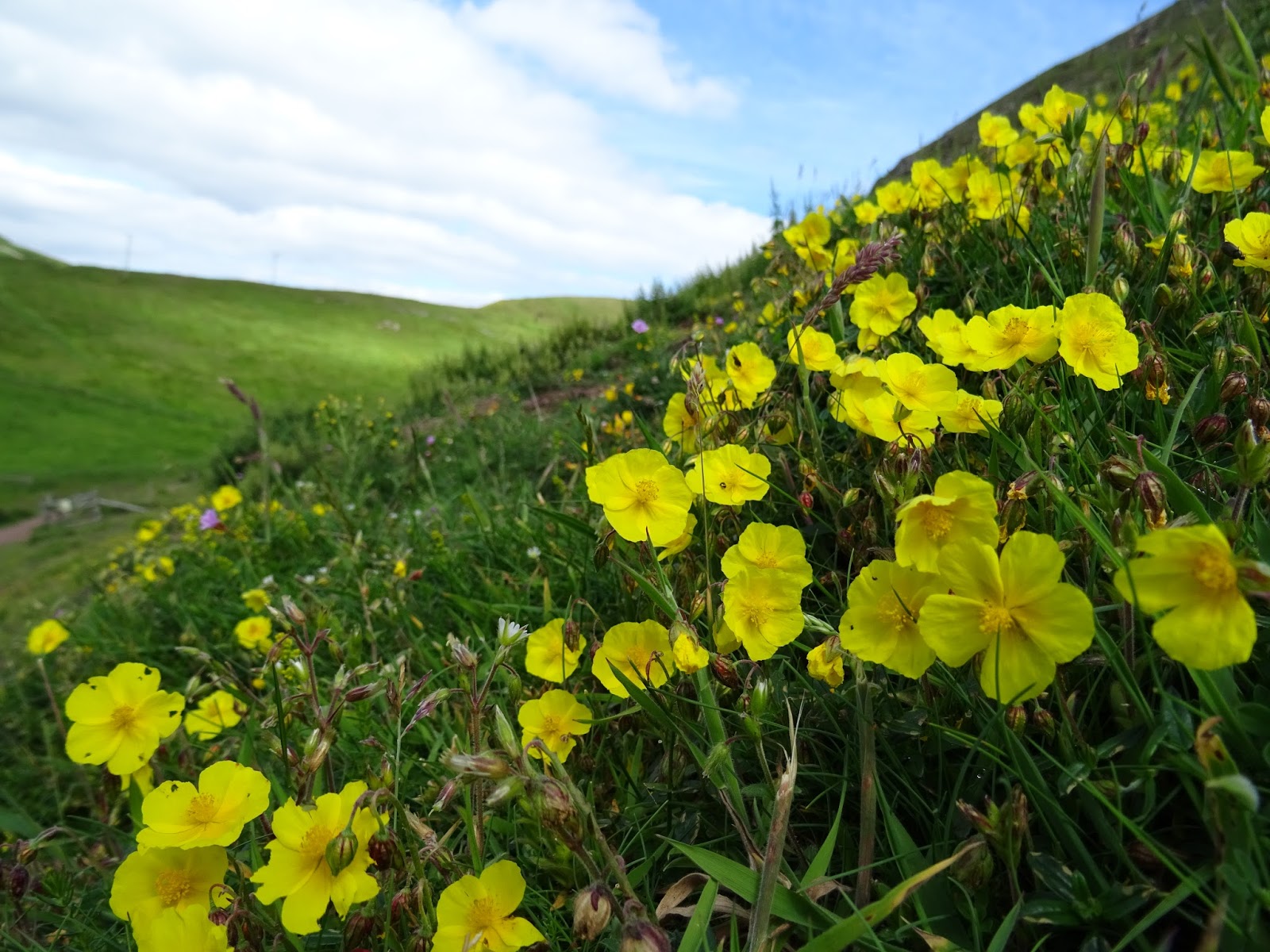
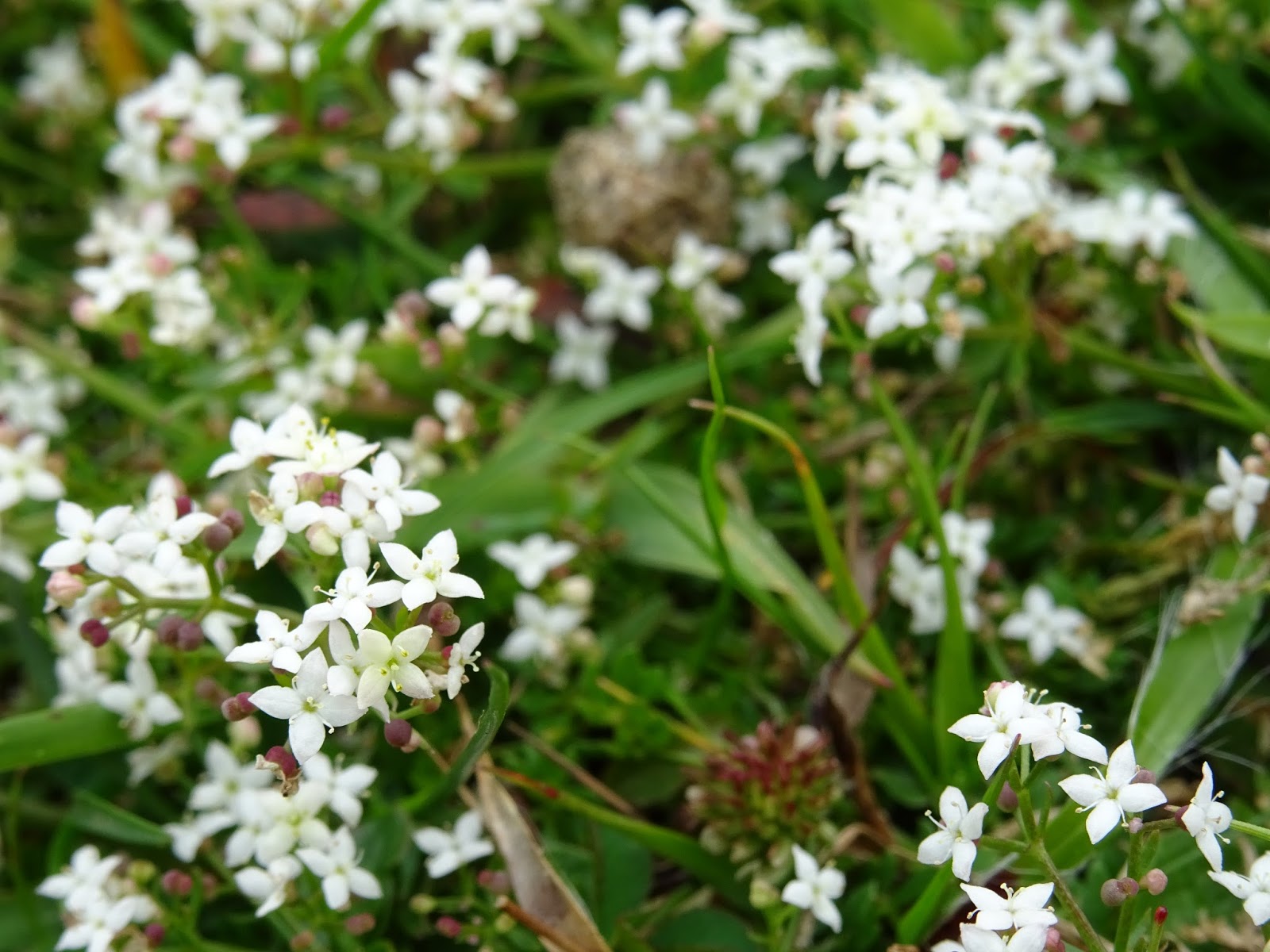
One of the reasons that St Abb's Head sports numerous nature conservation designations is because of its species rich grasslands. Now is a great time of year to get out there and see the huge variety that the reserve has on display. Just in case you cannot get herein person, here's a wee virtual tour!


Lots of splashes of yellow about; some with be bird's foot trefoil, which you can find in lots of different areas on the reserve. Thick carpet is on the clifftops at Foul Bay, you can see a blush of thrift (which is past its best) in the background. Bird's foot trefoil is a pretty common plant, but is rather beautiful with its splashed of red from which its alternative name of bacon-and-eggs arises.


Its really worth checking out any splashes of yellow you see on the reserve, because a lot of it will be this wee beauty at this time of year. Called the common rock rose, its actually not at all common, and its one plant that we take great care to manage the grasslands in favour of. Because it is a scarce plant in its own right, but also because it is the food plant of the caterpillar of the nationally scarce Northern brown argus butterfly. This picture was taken on the south facing side of Kirk Hill.


On similar well drained slopes you may come across carpets of purpley-pink plants, Wild Thyme. With their beautiful aroma when crushed they are a wonderful feature of the Head. Also common for the Northern brown argus, as they provide a nectar source for the adults. The yellow plant in the bottom right hand corner of this picture is ladies bedstraw, another flower you will see a lot of at this time of year.


Often mixed in with the wild thyme you may find this exquisite little flower, eyebright. This plant grows in lots of habitats from lowland moors to mountain tops and survives by being a semi-parasite - attaching its roots to and stealing nutrients from the roots of other plants. It gets its name from the fact that the flower looks like an eye, and in days gone by it was also thought to have medicinal properties for the eyes.


In the shorter grassland at the top of the cliffs you will also see patches of low growing white plants. These will most likely be heath bedstraw, a close relative to cleavers or sticky willy. You will find this in most grasslands that are not overgrazed.


In some areas of the reserve there is taller vegetation, much of which is a mixture of different varieties of grassland and also common sorrel. The sorrel's red flowers give these areas of the headland an orangy red hue at this time of year. In Tudor times common sorrel used to very prized for its sour taste, which was used in cooking very much like lemon is today.


Not all plants are so abundant and easy to spot from afar. This fluffy plant, Hare's-foot, clover, takes a little more finding. It likes to grow in sandy and rocky places, I came across this one at Horsecastle Bay. Its a plant that scarce in Berwickshire.


The wildlflowers of St Abb's Head are not only valuable for nature conservation reasons, they are also the icing on the cake - carpeting the stunning landscape with colour.


Enjoy!
Liza.